Tuesday, February 9, 2016

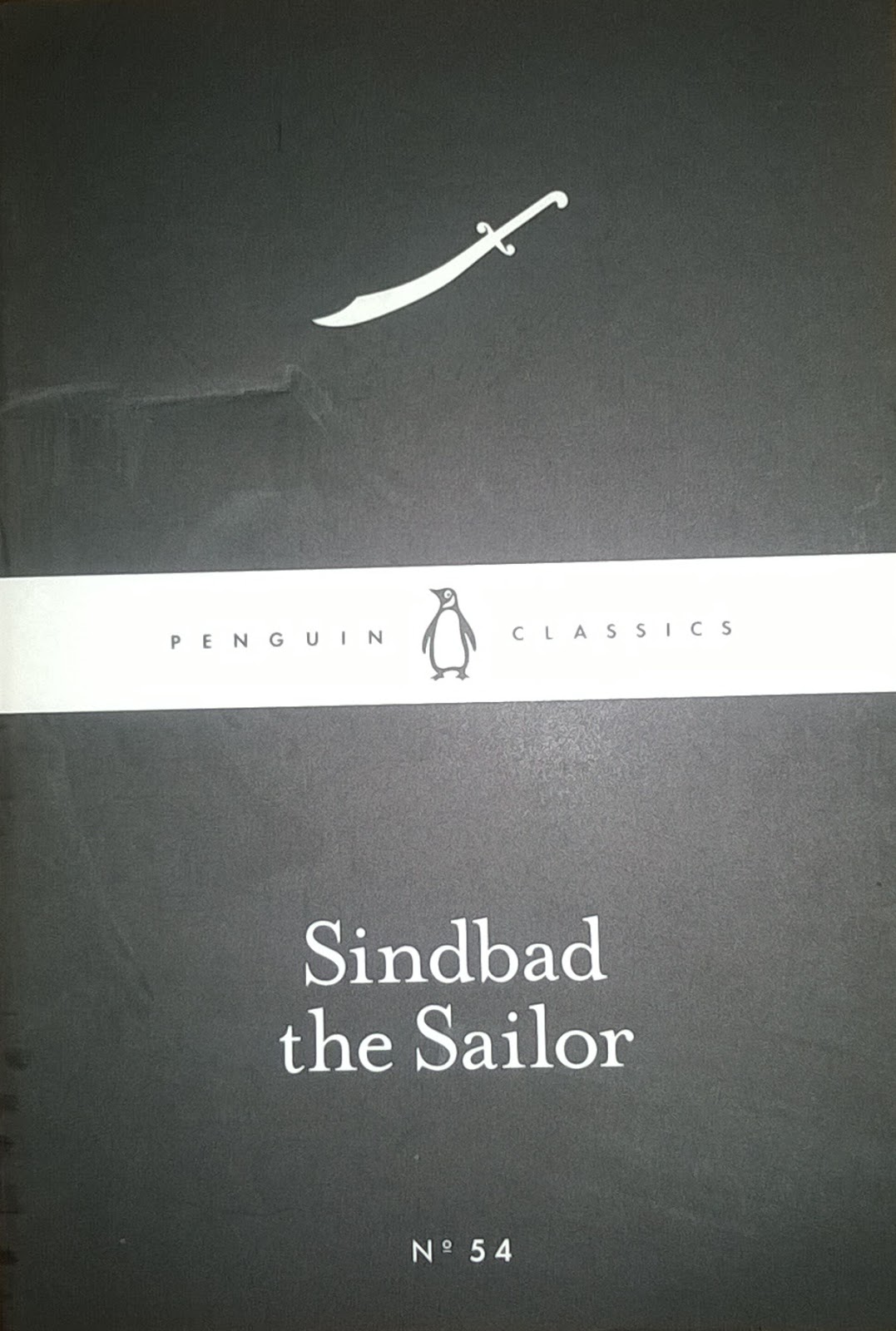
Sindbad the Sailor - Book Review

These are fantastic tales! Sindbad the beggar meets Sindbad the sailor by chance as he sings a lovely song about poverty and fate. Sindbad the sailor, a wealthy man who hears the song, invites the beggar inside and tells him some amazing stories of how he courted danger in search of fortune and how  he managed to come home richer from the experience. But the experiences are so scary that one wonders why he went back again. Surely Sindbad the beggar would have understood that riches do not court the weak and fearful. They court those who are enterprising.

In the first adventure called the 'Valley of Diamonds' Sindbad the sailor sets off to do trade in a ship. Somewhere along the route he gets off at an island where the ship has stopped and gets left behind. It's a lush island with fruits and fresh water. There is a huge dome of white that puzzles him. Sindbad realises that its the egg of a rukh bird, a bird so huge that it can cover the sun. He ties himself to the leg of the rukh, which flies off to an island, full of huge snakes. This is the valley of diamonds from which no man has ever come out alive. Those in search of diamonds throw carcasses into the valley and when birds of prey pick up that flesh, they hope to get some diamonds that get stuck on the flesh. Sindbad ties himself to the carcass but not before he gets a huge haul of diamonds for himself and then returns home a rich man.

In the second adventure titled 'The Black Giant' Sindbad sets off again and his ship is caught in a storm. They land on an island full of ape men who make off with the ship. From the ape men some of them escape and land in a place full of bones and a huge pot which belongs to the black giant. So huge is he that the earth shook when he walked. The black giant is a cannibal and he eats one of them - roasting them over a spit - right in front of the others. After three of the juiciest men are eaten, the others decide that they must make a break for it and they pierce the sleeping giants eyes and make off in a makeshift boat. On the next island the other two men with Sindbad are eaten by huge snakes. Sindbad makes himself a box of wood and survives the snakes. He somehow  makes his way to a ship. It's the same ship that the ape men had taken away and the captain is alive. Sindbad recovers his material and then uses his tradesmanship to make money before he returns home.

In the last adventure called 'The Cannibal King' Sindbad sets off to trade and his ship is wrecked. He lands in a dangerous tribe of Magians that feed people with food and oil that makes their bellies swell so the Magians can eat them. However Sindbad does not eat their food and stays away. He remains emaciated but sane while the other lose their senses. The Magians lose interest in him. Sindbad escapes and reaches a new land where he wins the favor of the king by making him saddles for his horses. The grateful king makes Sindbad marry a local girl and asks him to settle down. However the wife dies and the local custom is to bury the spouse with the dead spouse. Sindbad is buried in a cave full of corpses and he survives by killing all the live spouses who come down the cave with their dead ones and eating their food. In time he discovers an animal route to get out, takes all the belongings of the dead and escapes on a passing ship.

In all stories Sindbad survives by the skin of his teeth and by keeping his wits about him, He not only survives but makes a fortune as well because he takes brave initiatives when his existence is threatened, Sindbad is from Baghdad and his travels normally are form Baghdad to Basra. The story comes from the Arabian Tales. Fantastic stuff and full of gore and wonder.
Sunday, February 7, 2016

Serious Men - Manu Joseph

The story is set in an Institute of High Science with an impressive name in Mumbai - researching astronomy and black holes, time and extra terrestrial stuff. Serious men work there and try to promote their  pet causes and interests and projects. Led by the eccentric and brilliant Arvind Acharya the Institute is bumbling along mainly in pursuit of his Balloon Mission. But there is opposition for him in Namboodri of the astronomer group. To complicate matters Oparna Goshmalik enters the scene and messes with everyone's head with her youth and beauty.
A dalit clerk with an IQ of 148 and who had cracked the Mensa, Ayyan Mani, works as PS to Acharya. He is unhappy that his lot will never get into the Brahminical positions that the top scientists occupy how much ever brilliant they are. He uses his intelligence and his devious mind to falsely promote his son as a genius and also to find out all the secrets at the institute. Meanwhile Arvind Acharya stumbles into an affair with the desperate Oparna who is fatally attracted to him (she is fatally attracted to males in general). Acharya withdraws as quickly. Oparna is a woman scorned and she writes to the Ministry that Acharya made her forge the samples in his test project and there was no trace of extra terrestria life as claimed. Acharya is dismissed and Namboodri and his cronies occupy his place.

But Ayyan, who likes Acharya, has an ace up his sleeve - a recording of a private conversation between Acharya and Oparna that exonerates Acharya from the crime. Acharya is back. Namboodri is also caught on tape saying bad things about dalits and gets beaten up. Ayyan and his son continue cheating the system (why he would do that instead of getting his son to study all that is something I could not understand but perhaps Ayyan had his own experience before him).

Interesting the way the Brahminical society and the intelligent and devious dalit are pitted against one another in a scientific environment. The brahmin gets the girl and the top post. the dalit plays the sidekick and is happy in his place. Though a lot has been written about it as being funny and real, I found the novel an okay read. It is well written and the story is nice - just that it moves rather slowly and the characters are too low key. But the issues are real and that way, funny.


Saturday, February 6, 2016

Meeting Dilip D' Souza - Author, Activist, Free Spirit and a Gentleman

I met Dilip quite by chance a couple of years ago. He was in town to deliver a TED talk. My friend Anita Nair was in town to deliver a talk at the same event. She had an event to promote her book ‘Cut Like Wound’ as well. I was in conversation with her at the event and it was there that I met Dilip. The rest of the city had gone to a more high profile event with Amitav Ghosh or Gurcharan Das or someone else, so it was more like a bunch of friends that got together that day. Dilip formally launched the book that day and we stayed in touch since.
Dilip and Me

At the recent Non-Fiction festival in Mumbai we were both on a panel discussing cricket writing. That evening Miskil and I spent a delightful evening at his home in Bandra, bang opposite Sachin Tendulkar's house (Dilip's 'Final Test' is a critical evaluation of the Little Master's last test match), with his family.His other books include Branded by Law (about India's denotified tribes), Narmada Dammed (politics of development), Roadrunner (an Indian quest in America), The Curious Case of Binayak Sen and now, The Final Test.

For someone who is so unassuming Dilip is a much accomplished man with many awards to his credit (too many to mention here) and does many wonderful things. A BITS Pilani alumnus and an MS Computer Science from Brown University He writes mainly on social and political causes. Currently he writes a column for Mint on Mathematics and for other publications on sports and several other topics. Dilip is also described as an activist on his Wikipedia page - he is a member of the Managing Committee of Citizens for Peace in Mumbai, has worked with People's Union for Civil Liberties, Narmada Bachao Andolan, Ekta, was a member of Pakistan-India People's Forum, was on editorial board of the Consumer Guidance Society of India etc  He also supports Ummeed, an organisation that is engaged in child development - and as part of their fund raising walks the beaches in Goa - 55 kms a day every year.

Dilip was at the University of Hyderabad this week delivering a 3 day workshop on writing to the students of the Department of Mass Communications. On the last day of the workshop I stole him away for a few moments to speak to my students at the Department of Dance. It was an interesting question and answer session – why did you choose to write after a degree from BITS Pilani and Brown University and a lucrative career in software, how do you balance writing and money, how should we go about with our careers. Dilip told them that its about the journey. Though he is not trained as a writer he was drawn to it and enjoys the process. He’d like to be on the road if he wants to achieve something in this field.

We spent that evening at home chatting about this and that (including old girl friends and cricket). The next day I asked him if I could formally do an interview. Dilip graciously agreed.

Me: What is your average day like?
D: I try to wake up by 530 or 6 in the morning and get in an hour of work. Then the usual hustle and bustle as we get the kids ready to go to school. Then I get back to work again from 9 am to 12 am. Lunch. Back to work again from 2 pm to 5 pm. Some days I go to the Bandra Gym to play tennis. By now the kids are back home and hopefully before I hit the bed I try and get another hour of work.

Me: What are your hobbies? How else do you spend your time?
D: I read. Anything really. Non-fiction. Crime books. I enjoy reading Dennis Lehane the author of ‘Mystic River’. I am currently reading ‘The Song of Achilles’ by Madeline Miller. I enjoy listening to music. Older rock and roll and a few select Hindi songs. I love ‘Roop Tera Mastana’ and ‘Jaaneman Jaaneman’ which I remember singing with Vibha once. I have lots of music at home but don’t get time to listen to it. I was learning the piano and stopped. Want to start again. Want to explore jazz. I enjoy watching the odd film – the rare Bollywood film and more frequently Hollywood films. Then there is tennis and I am constantly on Twitter.

Me: Do you think your writing career is panning out that way you want it to?
D: Yes and No. I feel I’ve got to a stage where there is an audience that will accept what I write. But what's unsettling me right now is that I am not settling down to write my next book. I am not comfortable with that. I have written a novel – unfinished. I wrote 50000 words and then I got distracted and lost momentum. Need to get back to it.

Me: How has your progression been as a writer?
D: When I read my older pieces I see a naivety about it. But now I think I have become more nuanced. I feel when I read my older pieces that I was more angry. Now, I am angry but I can still put it across gently and in a better way.

Me: Do you think you found your voice?
D: Over the years I feel more like I found my voice. For long I think I copied the way my Dad wrote. But I think I write the way people speak so when people compliment me and say "I wish I could write like you etc" it feels good.

Me: How do you think you write?
D: I think I write clearly. With logic and reason. It's more about clarity. Style should serve the purpose.

Me: What advise would you give to any youngster on writing?
D: That 1)  Anything you write is about telling a story so find that story first 2) Look after the details 3) Flesh out the characters, observe people for little ticks that make your characters believable 4)  Provide a sense of place i.e. tell us about the place 5) Make connections, when thoughts come to you at tangents use them. Don’t dismiss them.

Me: Who are your favorite authors?
D: Jon Krakauer (Into the Wild), Pico Iyer, Dennis Lehane. And I absolutely love John McEnroe’s autobiography.

Me: And among Indian authors?
D: Naresh Fernandes (Taj Mahal Foxtrot, City Adrift), Suketu Mehta, Arundathi Roy

Me: Do you think there is a gap between foreign writers and Indian writers?
D: I don’t think there is a gap.

We ran out of time then so we wound up. But it was great talking to Dilip. We promised to catch up the next time I was in Mumbai and do a reality tour of Dharavi slums. That sounds interesting. In fact many things that Dilip does sound interesting like his campaigning for Ummeed and one gets the feeling that just by walking beside him and about him you will experience life at a whole new plane. Its an angle I like and admire. There is also a sense of balance about it all as he goes about it - his fine sense of humour and his firm, nonjudgmental and critical eye surely goes a long way into making it all fit into the same frame and coexist. So its easy to talk of my own superficial experiences with life and know he will listen with no judgment while I know that if I do scratch the surface of the subject matter of any of his books we would need days to even get to the heart of the matter be it denotified tribes or Narmada Bachao or Binayak Sen or Sachin Tendulkar or Mathematics or John McEnroe or Jazz music. Explosive stuff. I know nothing about most of the above. I will save that all for another interview (my excuse to ask stupid questions really!

Thanks Dilip. See you soon.


Friday, February 5, 2016

And some more stories

It's a part of our history. No wonder no one talks much about this secret - of caste. This is but one story.

http://www.vagabomb.com/How-One-Womans-Rebellion-Abolished-Keralas-Breast-Tax/

Wednesday, February 3, 2016

Asterix - The Mansions of the Gods

The heroes from the one tiny village in Gaul that the mighty Roman empire could not conquer are back. Caesar is brooding as usual as he watches the games at the Arena. He hatches a plan to entice the simple people of the village with the pleasures of the Roman life. He sends an architect Squareonhypotenuse to build lovely Roman mansions near the village. Then he sends Roman civilians to occupy the mansions knowing that the Gauls would not hurt civilians. All this is not easily done because Dogmatix is not fond of people cutting down trees. But the architect with the long name is not one to give up easily either.

The Roman civilians come in droves and infect the peaceful countryside. They cause prices to go up and pollute the minds of the villagers. Caesar's plan seems to be working when the entire village moves to the mansions. Getafix the druid and Obelix are captured (Obelix is tasting hunger for the first time!). Asterix is the last surviving warrior guarding the village against the might of the Roman empire and he does not have a drop of magic potion left. All he has is his courage and his wits until he can get some help. And help he gets when Caesar unwittingly aids them by throwing away all the food in the dungeons where a hungry Obelix is waiting for a morsel.

The 3D effects are great. It started well for me, seemed to lose energy a bit but ended up well enough again. Anjali loved it and laughed out loud many times. But what made it most interesting were the whispers in the beginning when grown people kept saying - Dogmatix, Obelix, Asterix, Vitalstatistix etc. Popular bunch they are. If you've liked them, must see.

Tuesday, February 2, 2016

Rohith Vemula - What We Have Made of a Dead Man's Last Wish

So with great alacrity and care, everyone from the Union Home Minister to the Education Minister to all sorts of high powers have established that Rohith is not a Dalit (apparently intelligence reports have reached them!). I don't know if his family should celebrate this elevation given by the government - something they might have liked it to do, even if it a symbol of equality, when he was alive. The powers that be, the media have also found out that his mother is a liar (though she claims otherwise that she is a Dalit). That Rohith himself could be a liar (for having claimed SC as his caste) which is a much smaller offense than the other things they have found out. That he is also anti-national and is casteist (all concerns shown by esteemed ministers).

www.hindustantimes.com/static/rohith-vemula-an-unfinished-portrait/
(a fine report by Sudipto Mondal, someone who made the effort to go beyond and find out more)

So thanks to the government's ceaseless efforts, all of us are now absolved - it is not a Dalit suicide! Especially those who may have faced repercussions if Rohith was established to be a Dalit. All efforts have been made and will be made to ensure he is not a Dalit. (Surprisingly now he is not a Dalit, does he still have to bear the 'casteist' sigma or will that be expunged from the record?)

So what does that make him? A non-Dalit?

http://www.hindustantimes.com/india/official-certificate-scotches-doubts-over-rohith-vemula-s-dalit-identity/story-6mppXAleTcXjSAyJfXK2VM.html

More importantly what does it make us, whom he left behind?

http://indianexpress.com/article/india/india-news-india/rohith-vemula-suicide-carl-sagan-ann-druyan-hyderabad/

What it does make him is someone who is not a Dalit, as per the government. But whatever little I have read about his life is not different from one. He came from a broken home (hopefully no contention on that), who struggled through his life and achieved what he did with high ideals and surely effort (hopefully no contention on that because he seems to have got the admission on his own).

www.huffingtonpost.in/2016/01/28/rohith-vemulas-death-is-c_n_9096752.html

He somehow seems to have believed that he was a Dalit which is sad because now the government says he is not Dalit. He did not secure admission by using that now 'privileged' card. And certainly he seems to be a Dalit sympathiser being part of the ASA (Ambedkar Sudents Union, which is nowhere as fashionable as ABVP or any other student bodies because this simply represents 'those' unfashionable people). So this boy who believed he was a Dalit died perhaps for being a Dalit sympathiser which seems to be bad enough to warrant it.

So who owns Rohith? The non-Dalits? The ones who were quick to point out that he is not a Dalit? If a non-Dalit died then, should they not be mourning that a bit more? Or is their hatred towards the sympathy Dalits were getting in the ensuing political frenzy even more than the mourning they must do for one of their own?

scroll.in/article/802785/radhika-vemula-lost-her-son-now-shes-being-insulted-by-the-modi-government

Truth is no one will now own Rohith. Perhaps the Dalits will own him even if it is proven that he is not a Dalit. After all he did more for their cause than anyone else's. Than his own certainly.

What have our authorities done in their quest for the truth? They have shredded and torn and maligned the gentle, almost fearful words that Rohith wrote in his last letter. It was almost an apology cum a plea to leave his friends and enemies alone. Unfortunately he forgot to include himself and his family in the list of people to be left alone. Look what we have done for that careless mistake young man - we have just ripped your whole life apart - in your death.

So the memory of the boy with no caste (taken away by the government and a higher status deemed perhaps), now remains that of an anti national because he protested against Yakub Memon's hanging. Is there a law against that? (I wonder what then happens to all those people in Bollywood and outside who show great sympathy to Sanjay Dutt? To those who have deals with Dawood and the like? Are they also anti national?)

scroll.in/article/802785/radhika-vemula-lost-her-son-now-shes-being-insulted-by-the-modi-government

To say we, as a society, operate in an ocean of hypocrisy would be an understatement. But we have climbed another rung lower now. That we have no respect for the living is a known fact. But we have lost all our respect for the dead as well. There is little hope for a society if its leaders cannot put things into perspective. If it cannot be kind and understanding of its own children. If it has no qualms in dancing over the graves of those who could not bear it any longer.

My friend said - he does not deserve to be there. If he is so weak he should not get into activism. He should study.

How harsh is that. How hard. What have we become?

Let's consider another scenario.

Forget for a moment that two groups fight on the campus and one of them ends up getting bruised. Let's say two boys within the ABVP had fought among themselves. Would the Minister have taken up the issue and written to the Education Ministry? Would the education ministry have written to the VC? Would the VC have banned those?

Not likely.

In the end - if one were to take the government stand - it is a case where a non-Dalit boy died because he sympathised with Dalits perhaps. He probably had other reasons leading to his suicide (someone suggested that surely). Meanwhile the honorable and esteemed ministers and vice chancellors were merely writing routine letters to one another accusing students and campuses 'routinely' of having become dens harbouring anti nationals and casteist groups. And since it is not a Dalit versus non-Dalit issue, we are fine. (But if anyone talks in support of the other viewpoint we may include you in the anti-national and casteist list too.)

Rohith was very close to the truth when he said we are reduced to a vote. He got no justice while alive. Worse, even when dead. Whatever identity he claimed (do we have any charges that we can press against the family for that?) has now been taken away. Now he belongs neither here nor there. Like Manto's Tek Singh, Rohith dies in no man's land. Hopefully now, he will find peace there. His family has been stripped of whatever dignity they had and have been branded as liars and what not.

This is what we have achieved in the end. Other than the VC going on leave. And the acting VC going on leave.

This is what we can do to our youth if they open a dissenting thought.

This is what Avirook Sen calls - how India looks from the ground. Surprisingly in starkly different ways the cases of Rohith and Aarushi Talwar are also similar - of bias, incompetence and inefficiency. Of not respecting the dead.

In retrospect, the 'anti national' young man displayed far more grace, responsibility and forgiveness in his death note than what the collective powers are doing. It does not paint a pretty picture at all.

There is a universal principle however that we cannot escape from - what we give, we get. So beware our actions, our thoughts and our intent. They will come back to bite.


Monday, February 1, 2016

Anjali - Accentuate the Positive

Anjali 's dog phase extends to Max, my brother's beagle, who lives upstairs. Once in a while she goes up to play with Max and enjoys her time there.

The other day she came back with a triumphant look on her face.
'I taught Max how to sit,' she said.
Wow! A trainer!
'How?' I asked. Max is a tough fellow, rather obstinate.

'I showed Max a piece of food and he came running. I told him to sit. He still came for the food. But I insisted that he sit. After some time he understood and sat. Then I gave him the food. Now when I tell him to sit, he sits down first, and then I give him the food,' she said.

Very nice. I know from personal experience that she can be a ruthless teacher or facilitator - she does not give me a whiff of a chocolate on my non-chocolate days (The entire week save Sunday as decreed by her). My most heartfelt pleas are brushed aside until the desired behavior is displayed.

'Sometimes he sits even when I don't have food,' she said.

I read Ken Blanchard's 'Whale Done' and he talks exactly the same thing - about how they train whales to perform at the Sea World by 'accentuating the positive' behavior so trainees repeat that behavior. The whales are given a reward after they perform the actions that the trainers seek.

I am trying to get a couple of organisations to see the wisdom of this. I can understand how difficult it is for managers to see the wisdom of investing time and training behaviors. Glad Anjali got it right.