Inspired by the VNR VJIET TEDx Event where they had a stall with a bunch of new books - all book suggestions by various people - to give away for free. People could go, pick up a book they liked, read it and pass it on. I found it incredible that someone would do stuff like this and remember I actually asked the boys 'For free?' How difficult is it for us to accept the good that comes to us. But I can expect nothing less from the lads and lasses especially under the stewardship of Abhinay who comes up with some wonderful ideas and pulls them off. The boy at the counter suggested I read "Twenty Thousand Leagues Under the Sea" by Jules Verne and I was glad I picked it up.
This is a bunch of books that Sagar gifted to me - what goes around comes around
I suggested the idea to our colony committee members - that I would like to give some books away for free for anyone to take away and read if they gave me some space in the committee hall. They took a lot of time to understand the idea.
'You will sell second hand books?'
'No, I will give them away for free.'
'You want to give books for the library?'
'No I want to give books away for free.'
'You want people to read and return to you?'
'No I want to give books away for free. Anyone who likes any book can take it away - no questions asked - and read it and pass it on. No obligation to return.'
That is when one of the gentlemen seemed to get the idea.
'Wonderful,' he said. 'I will give you space next function.'
So I was glad when I bumped into him recently and he said there was a function coming up on Sunday and he would give me a table. I said that's wonderful and we picked up some 25-30 books to give away. 'My Experiments with Truth' by M.K. Gandhi, 'Siddhartha' by Herman Hesse, a couple of Enid Blytons, Fit for life, A book on Yoga, 'Don't lose your mind, lose your weight' by Rijuta Diwekar, some National Geographics and several other books for all ages. Contributions came from my shelf, Shobha's and Anjali's.
Anjali then made a small poster that went like 'Books for Free' - Take any books you like, Read it and Pass it on. There was a trademark smiley at the end. We stuck it up on a pole near the table and spread all the books out.
A small boy came immediately and picked up the Enid Blyton. His mother came and told him to put it down. He put it back. I stepped in and told the mother that the idea is to take the books away for free and read and share. He could take ti if he liked it. She looked a bit stunned and surely was wondering what the catch was. The boy got his hands on the book and I hoped he would take it home.
Anjali and I got back home and went back to the function after an hour. Most books were still there. People were still wary if there was a catch. They would see the books and put them back on the table. I let them figure it out - I could see some young kids reading the poster and pick up books. But they put them back.
But suddenly one old lady went and picked up a couple and then someone else did and within a few minutes most books got taken. I was surprised that Gandhi's autobiography and Siddhartha were not taken. I suggested them to the young lady who stays in the flats opposite my house - it would have been appropriate because she was Abhinay's junior and is from VNR VJIET where I first saw this experiment.
Hopefully she picked them up. I told the committee members they could give the books away or put them in the library or do whatever they want to do with them. Nice!
Fabulous stuff!
Trust is built in really small moments.
BRAVING - Her acronym for trust!
B - Boundaries - are we respecting boundaries of our own and others
R - Reliability - are we delivering what we promise repeatedly, are we doing the thing we say we are goign to do over and over again
A - Accountability - Are we being accountable, can you own a mistake you can apologise and make amends, and allow me to own my mistakes and make amends
V - Vault - are we keeping our confidences, ours and others
I - Integrity - are we
N - Non judgmental - about self and others, can we ask and give help, reciprocate, if we cannot ask we are not good enough to give
G - Generosity
And in combination with what Google's team has researched and 'found', it makes profound sense - this is what psychological safety is all about!
5 Keys to a successful Team - 200+ interviews, 250 attributes of 180 teams Who is on the team matters less than how team members interact, structure their work and view their contributions.
Impact - team thinks that work matters and will create change Meaning - Work is personally important to members Structure and Clarity - Team members have clear, roles, plans and goals Dependability - Members get things done on time and reach Google's high bar of excellence Psychological Safety - Team members feel safe to take risks and be vulnerable in front of one another
5 Keys to a successful Team - 200+ interviews, 250 attributes of 180 teams
Who is on the team matters less than how team members interact, structure their work and view their contributions.
Impact - team thinks that work matters and will create change
Meaning - Work is personally important to members
Structure and Clarity - Team members have clear, roles, plans and goals
Dependability - Members get things done on time and reach Google's high bar of excellence
Psychological Safety - Team members feel safe to take risks and be vulnerable in front of one another
To boost your brain power, creativity and energy.
1. Look at "what if" scenarios
Think the exact opposite of what was being done. If they use 20 slides, use 5. If they use words, use pictures. Think out of the box because if you do the same thing, you will end up with the same results. Break out.
2. Think 10x and not 10%
Don't think incremental if you want radical results. Think 10x and work backwards.
3. Get into the flow
Once you fix the 10x target, get into the flow. Get excited about the job. Imagine the outcome, how it will help others, how you feel after achieving it. Get complete focus, eliminate distractions, song, routine. Get yourself into good energy.
4. Write lists
Break the minds patten. Write random lists that force your brain to be more creative. Write lists about top 10 books, bands, whatever. Just get the mind thinking.
5. Change perspective
Think like how a champion would think in this situation. Watch a TED talk or read an article to inspire you to see it differently.
6. Zoom Out
Work in pods of high focus. Pick important tasks and give it 100%. Present the final outcome as if you have already achieved your result and explain how you did it.
There are times when we face situations that require us to do something extra ordinary to win. When you could seize the moment and make it yours, when you could create a win out of a potential loss. When you display Personal Leadership at its best. These situations throw themselves at us on a regular basis. Just like it happened to Harmanpreet in the Women's World Cup semi-final. Can we convert a probable loss into a win? By design?
Much has been written about Harmanpreet's innings of 171 from 115 balls that knocked Australia out of the Women's World Cup semi-final and is still being written. That it is the best knock in women's cricket, that it takes women's cricket to a new level, that it is the best World Cup knock by an Indian etc.
Let me analyse the lessons to learn from it - on how to turn in a match winning performance when the heat is on. More so when it is a match your team has to win against a tough and supremely confident opponent. You have to turn in something superlative, something out of the world, and she did it. Here's my understanding of what she did right.
Lesson No 1. Understand the situation, Play Yourself In
Harmanpreet knew the significance of the game. India had lost badly to Australia in the earlier round and though they bounced back and beat New Zealand to get into the semis, the team was visibly wary of the strong Australian side. The loss of two early wickets for 36 and some disciplined bowling by the assured Aussies meant that she and Mithali Raj had to build the road, slowly, brick by brick. She did not try and dominate right away. She got her bearings first and understood the situation. In the first 39 balls she scored 19 runs.
Patience. You cannot get runs if you are back in the hut despite the grandest of intentions. To make a difference you must be out in the middle.
Lesson No 2. When You Start Seeing the Ball, Hit it
Once Harmanpreet started seeing the ball and realised that there were no demons in the bowling nor the wicket nor the weather, she started hitting the ball hard. Clean cricketing shots mind you. Fully in control. She adjusted her shots intelligently to find the fence more than once but always played correct cricketing shots that had low chances of getting her out. Full face of the bat, high backlift, watch the ball and smack it.
Play safe. Play hard. Push hard from safety. Lesson No 3. Don't Take the Foot Off The Accelerator
Many great innings are marred by the slowdown near the hundred. Like her idol Sehwag, Harmanpreet did not slow down. But she went one better. Where Sehwag gets it over with a six, she hit hard shots along the ground. Not for a moment did she slow down for her hundred; she still stepped out as aggressively and hit the ball as hard as she could. No slow single, then another for her hundred. The ball was there, the team needed the runs and she was going for it.
Don't slow down the momentum for personal targets. Keep going. It's the same bowling, the same wicket, the same situation.
Lesson No 4. Keep the Partnership Going
Harmanpreet stitched a brilliant partnership with Deepti Sharma who played a wonderful supporting role. The moment she got strike the left hander dutifully took a single and gave the strike back which apparently was the plan and a very sensible one too. Such a wonderful partnership, such self less play, I have not seen in years. Harmanpreet went for a stretch two on 98 and was livid that Deepti almost got herself run out on a reluctant second. No celebration for the hundred, just livid that such a crucial partnership almost got cut short because of a bad judgment call by her partner. The two put on 137 runs that put Australia out of the game, Deepti got 25 of those.
Build partnerships. Nurture them. Care for them (even if you have to shout at them). Then put your arms around them. It's all about partnerships. You cannot do it alone.
Lesson No 5. Don't Be Easily Satisfied
Many greater players have been guilty of giving up their wickets after reaching the 100. Satisfied that they did their part. That a 100 in a world cup semi-final is a big deal and especially under these circumstances. A casual smile, a big shot, a cute reverse sweep - how many times have we seen these show off tactics in men's cricket that ended their innings. But no such cuteness from Harmanpreet. She was fully focussed. There was a job to be done and it was far from over. She knew the Australians could always threaten whatever the score - and they did. She knew she had to bat them out of the game.
Don't be easily satisfied. When you are in, keep going. Keep building. Good is not good enough. Go for great. What will make the difference is what you do after that 100. Lesson No 6. Keep Going Through the Pain, Glory Does Not Come Easy
One inside edge and she hurt herself. The slight hobble was evident. The fatigue certainly should be showing now. One false shot was expected. One foolish shot. One small loss of concentration. But despite the pain, fatigue, sheer number of balls she was facing, she kept going, on and on.
There will be pain when you want glory. No excuse. Pain, rain, whatever. Keep going through it.
Lesson No 7. You Have Not Finished the Job Until You Have Dominated the Opponent Out of the Game
It is easy to go for a big shot and get out after her 150, when the job was almost done. No one would have minded. She was tired, she was in pain, she had done more than enough. Not for her. There is a difference between almost done and fully done. The job was still to be done. India was well past 200 and going to 250. But she still hit correct cricketing shots. She did not lose her concentration.
By now she had in some parts achieved what she set out to do. She had pushed the Aussie team into confusion; their body language was down, their confidence shattered. They had no answers. She had beaten them mentally. She still did not let go. She did not take the luxury of dragging the off side ball to midwicket - she still hit the ball through cover for four. Even in the last couple of overs. Dominate the opponent, beat them into dust when you can. Don't let them get up. Show no mercy. Always be wary that the one extra run could make the difference.
Lesson 8. Balance Aggression With Caution
It was not pure aggression. Aggressive she was but this knock was more about how she blended it with an amazing amount of caution. No false shot, no unnecessary risks, just pure clean hitting. Nothing fancy ever, no deVilliers like fancy footwork though it must have been tempting.
Aggression with caution. Push without losing your position of safety. Don't over reach and yet don't take the pressure off. Lesson No 9. Do What You Know, Do Not Attempt What You Don't
Harmanpreet backed her strengths, her strong areas and kept going. She never tried things she did not know, never played those net shots you do once in a while when ego and pride takes over after you piled up a big score and you desperately want to show the world your expertise.
Follow the process. Do what you can do. Don't do what you cannot. Remove all that is not you.
Lesson 10. Always the Team, Never Herself
Harmanpreet, if anything, played for the team and not for herself. Clearly that was the only thing on her mind. Not her six hitting prowess, not her shot selection, nothing. She just wanted enough on the board and did everything she could - hobbling through her uns, hitting through, keeping the partnership going, right till the last ball.
If you play for the team, a bigger purpose, you hit your best form far more often than otherwise. You hit the zone when you go past the ego, the I.
Those are my 10 lessons from Harmanpreet's knock. In times when you are faced with a situation when your team needs you to bail it out, when it needs you to do the impossible, think of what this young lady did, and you could pull it off too and cover your team with glory.
These are the practices that are advocated in the book 'The Seven Spiritual Laws of Success'.
1. Law of Pure Potentiality
1) Practice silence - Simply BE for one hour every day.
2) Meditate - For 30 minutes. Experience stillness and introduce a faint impulse of intention and the desire to create. Stillness is the first requirement to manifest.
3) Non judgement - Judgment constricts flow of energy between you and the field of pure potentiality. Non judgment crates silence in your mind.
4) Spend time in nature
2) The Law of Giving and Receiving
1) Give a gift to everyone, a smile, a blessing can also be a gift
2) Gratefully receive all the gifts life offers
3) Keep wealth circulating in your life by giving and receiving caring, affection, appreciation and love.
3. The Law of Karma of Cause and Effect
1) Witness the choices you make each moment. Bring it to your conscious awareness.
2) For every choice ask - will consequences bring happiness and fulfillment to me and those who are affected by the choice
3) Ask your heart for guidance through the feelings of comfort and discomfort
4) Law of Least Effort
1) Acceptance - as things are, as people are
2) Take responsibility - do not blame anyone including yourself, think up creative responses to the situation
3) Defencelessnes - don't convince or persuade others to see your Point of View. Don't defend. Be open to all POVs.
5) Law of Intention and Desire
1) Make a list of all your desires, carry the list everywhere and look at it frequently
2) Release this list of desires and surrender it to the womb of creation
3) Practice present moment awareness in all actions
6) Law of Detachment
1) Commit to the law of detachment. Allow yourself and others the freedom to be as they are. Don't impose ideas on how to be or do. Do not force solutions on problems. Participate in everything with detached involvement.
2) Factor in uncertainty as an essential ingredient of your experience. The more uncertain things are, the more secure you will feel. Uncertainty is your path to freedom. Through your uncertainty you will find your security.
3) Step into the field of all possibilities and anticipate the excitement that can occur when you remain open to infinite choices.
7. Law of Dharma, of Purpose
1) Pay attention to the deep stillness within your heart.
2) List your unique talents. Employ unique talents in service to humanity - lose track of time and create abundance
3) Ask yourself - how can I serve, help. The answer will allow you to help and serve human beings with love
Apache is Divya's eight month old dachshund. We could hear him barking while at the gate but once he had access to us, he was unstoppable. It was the longest production of a welcome scene filled with overflowing enthusiasm, high energy and love that I have ever seen. It lasted through the half an hour we spent there but the first fifteen were all Apache's.
Apache on the lookout to spread some love
He licked, pawed, climbed over and even held on to me while I was going away in a fashion that little children do. He somehow managed to get his little paws around my leg as if saying - 'Don't go'. All the while that we were there he was running between us, jumping on the bed and off, making his affections known to us in a way that one cannot ignore. Only after fifteen minutes did he shift his attentions to the chewy bone he had. But he had us in his sights all along.
Apache spreading love to the pillow
Divya said that this is how he is always and it takes a long while to get him under control. We wondered if this is how we should all be - full of enthusiasm and energy. That welcome that he gives might be something to emulate for us - making others seem like they are so special, like they were the centre of the world. We laughed about how Apache was probably trying to teach us a lesson there. Shobha said that perhaps if we welcomed people who came home like that, our lives would be different maybe.
Not a bad thing to be aware of and practice. A no-holds barred welcome, a way to make others feel like the world is all about them. Hmmm.
My mom, Kalabathula Savithri, eldest daughter of Kalabathula Venkayya, hailed from a tiny village called Padmanabha Cheruvu in West Godavari district. Her father was a respected government school teacher I was told. Her mother was the gentle and beautiful Sastrulamma. She had a sister too. Mom went to school and I always thought she discontinued after her 5th class. But I found a Teacher's Certificate certifying that she passed the Training School Leaving Certificate Exam in March 1948 (she was born on January 18, 1932) which means she was sixteen when she passed out as a teacher. She studied at the Government Secondary and Training School for Women, Narsapur and had passed out with 48%. G. Cattell was the Headmistress who signed the certificate with her beautiful handwriting. Mom signed in Telugu.
The Headmistress's impression of her was "Very reliable, mild and pleasant. Takes corrections very well. Takes the initiative. A very fair teacher.' - signed on April 9, 1948. Pretty accurate.
This is how I remember her - happy with her coffee early in the morning
Turns out Mom and other trainees were tested in Physical Education (7 steps, 7 jumps, 7 hops, 7 skips, 7 rope skips, 7 ball throws, 50 yard run) in organised games and gymnastics - average. Then they were tested on handicrafts (very fair), character and conduct (v good).
Mom scored higher than class average in Theory and Practice of Education (Principles of Education and School Administration), Methods of teaching school subjects (Language, Math, General Science, Home Science, History and Civics, Geography, Rural Social Problems).
'Shows keen interest, very regular and improved, calm and cheerful, tries to do well' are other comments. She was pretty good with her attendance.
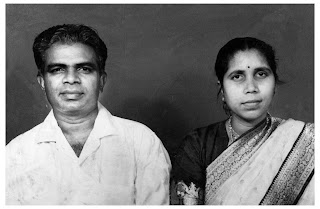
Dad, Paruvu Venkanna, and Mom, Kalabathula Savithri (1970s)
Mom must have been pretty young when she married my father who was a full-fledged Engineer from the Guindy Engineering College, a voracious reader, with a finely acquired taste in music and a much wider world view than she could ever have. But from what I saw of her since the first memory of her, she never let her lack of education (I always thought she had studied only till her 5th until I found this certificate - how little we know of our own) get in the way. She always operated as an equal - be it with the Collector of the district, a Minster or even an actress. She had a presence, dignity and a strong character that made people of much higher status and standing respect her immensely.
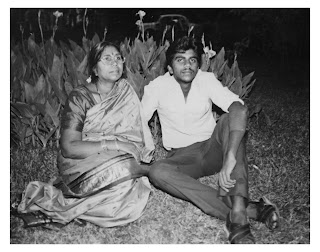
Must have been early 50s - just after their marriage
For example, her best friends were all highly qualified doctors - Dr. Savithri, Dr. Satyabhama, Dr. Sita, Dr. Ranganayakulu - and they would come miles, travel between towns if she needed them. I spoke to Dr. Savithri recently when she came home for Anjali's birthday and asked her how they got along considering the disparity in their education and she said without batting an eye lid. 'She had common sense which we did not have. Imagine how she handled life after your Dad's death. No one could have done it but she.' True. I never felt the lack ever in the years after Dad passed away.
A typical smile - Me and Ram (Eluru, 1970s)
I don't think Mom lost a friend ever, lost a relationship ever. The vaguest people remember her. Two years ago (more than ten years after her death) when I went to register my gas connection (with the Aadhaar) the clerk in the HP office looked up when he saw our address. 'How is madam?' he asked. I was surprised. 'What madam?' I asked. "Your mother," he said, "I can never forget her voice over the phone. There was something warm, affectionate and kind. She'd call when you needed a gas. Always made me feel special." Wow. That was something. The butcher remembers her, the Binny retail shop fellow remembers her, the grocery shop wala remembers her, the vegetable vendor who pushes his cart remembers her - and not just normally - with true affection and respect. Mom I think had this wonderful way of making people feel special, feel cared for. They connected to her and stuck to her for life and even after. From peons to drivers, officials to highly qualified people, they all remained forever faithful to her. There was a shop in Eluru which would send her whatever sarees she wanted without her payment for years after we moved out.
There was a small coterie of uncles and nephews who could kill for her. They'd be in a huddle, conspiring with her, on what was to be done and more often then not did the right thing. They would materialise overnight at our doorstep - all she had to do was summon them and they'd come without delay, without a question. Left to my father's planning we would have been homeless and probably educationless by now. It was she who realised that father's service was dwindling and there were five children, three of them daughters who had to be married and two young sons still in school and got him to build a home. A home that she oversaw personally while it was being built, incorporating designs she saw in Chandamama or some other magazines and coaxing the workers, masons, carpenters, to give her their best work. And they all would have died to do it for her. The same home gave me the comfort to take a decision to write.
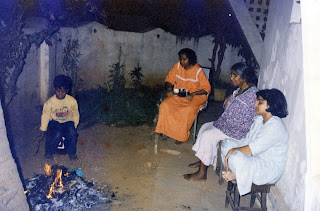
Enjoying a bonfire - 2002
She remembered every little thing - birthdays, anniversaries and made appropriate gestures. Always something appropriate, big or small. Definitely a telegram would go if she could not attend. Money would go for those who needed it even if her own position was not the strongest. Clothes, gifts..somehow she knew what they needed and got exactly that. She'd be there physically for them when they needed her. All of which was amazing considering her background.
She had this amazing curiosity and willingness to learn. She hired a school teacher L.T. Ramasarma to teach her English when we were in Eluru (early 70s) and learned enough to sign and read and write. This when I was five, and I remember later reading the books she was learning to read - The Trojan Horse was one and some other fine books. She loved good cinema and I enjoyed watching 'Ankhiyon Ke Jharonkhen Se' with her. She enjoyed music, flowers, her little garden.
Mom had this tremendous clarity and strength. Once she decided on her course of action she would not think twice about doing it. There was apparently once an issue when my father was threatened by some supposed-naxals to pay them money. She chanced upon their note, called the Police Chief of that district and sorted it out overnight. My father had been struggling with the issue for a long time.
Mom and I planned on a trip to Kanyakumari and Varanasi which we never did. But I am glad I coaxed her to make the US trip to meet my cousins - all alone. She did, mustering all her courage and making a foreign trip by herself. I am so glad she went though at the last moment at the Bombay airport, she very cutely, asked me if we could cancel the trip and go home. I told her they would take care of her. She was nervous but nothing can stop Mom.
In Tirupati with Mom
Dad's great romantic idea - a huge card for Mom on her birthday on a wooden plan from all of us
A classic - all of us Mythily, Aswini, me, Dad, Ram, Mom, Nalini and Lakshmi
When she finally fell sick with colon cancer in 2000-01, I was fortunate to be there to hold her through that period. We'd talk so much during those hospital visits and she'd tell me all the things that happened - my father's lack of financial prudence, how she was told there were things called banks when she was well into her forties and how she then planned her finances, We'd sit in the little canteen in St. Theresa's and I'd listen to her stories as she told me in that quiet, amused and measured manner. I once told her to write about her life and she wrote two paras - two paras of the most beautiful prose I have ever read in Telugu. She described the route to her school, the flowers, the little birds, the skies - just blew my heart away. I wish she'd written some more.
It was a tough period during her illness as she slowly sank and the pain increased and she lost her faculties. But it was time for the family to rally around and everyone came, siblings, nephews, nieces, uncles, aunts. Ram came down from Bombay and he was a huge help in that situation which was fast threatening to go beyond my control. Mom finally passed away on January 13, 2002.
I loved the way she started her story with an Om Sai Ram and her wonderfully descriptive lilting language.
She had this wonderful zest for life. I remember getting her this tandoori chicken when she was in her last days and the way she relished it. We loved our food - she and I and were fully carnivorous. I suspect Dad did not like her giving me a long rope, letting me play cricket etc. But when we went to buy groceries, she'd allow me a soft drink and if I gulped it down quick enough, she'd throw in a bonus, another one. I'd love that. For years she'd come with me and get my cricket whites stitched - I think I was the only guy in the Ranji team then who played with stitched whites. All else were wearing tracks.
Her conspirators - Leelamma and Sampath Rao mamayya
On my birthday she's always give me a hug, a kiss and an apple. Maybe even a card and a chocolate sometimes, but this was a must. It was such a warm beginning to the day. Of course she worried about me and would wonder how I'd get by with my text book ideals about life and narrow inflexible boundaries. I'd laugh and then she'd laugh too. Never in her wildest dreams would she have imagined that I would turn into a writer and Ram into a film producer and director. But knowing her she would be pleased as punch to know we are doing things we love.
Mom's blessings after marriage
She gave us so much freedom and we never abused it. I'd come home at 2 or 3 in the morning during college days. She never said do this or that. She let us choose and we turned out ok. She'd consult all the right people though to help. She'd have her army of astrologers and pujaris (who still ask after her) and try to sort out my stars and that of the others.
In the US with her nephew Ratan Raj
For her background she knew enough about nutrition or figured it out. During my playing days I'd leave home at 6 in the bus, go to Gymkhana play till 930, go to Osmania and attend classes till 1, take a bus back to Gymkhana and eat a pastry or a puff before heading into a three hour practice. Once Chakkar caught me eating a pastry and he made such an issue of it - 'This is the diet of a Ranji Trophy player'. I never thought of carrying a dabba thanks to the long time gaps, but Mom set me up for the day with a double egg and a couple of solid chapathis. I can still taste them, feel the strength they provided me to get through those days.
Today is Mom's birthday.
I used to call my siblings and celebrate it earlier but today I felt like being alone with the thought. I remember buying her a remote controlled television as a birthday gift for her in her later years - smuggling it into the home after she slept (one of the few gifts I bought with some thought, one of the few surprises I planned in my life). She was so happy with it - else she had to walk up to it and change the channels. I somehow wonder what all I could have learned from her if she was around now, when I am a bit out of the fog and clearer. I could have had long discussions, taken her advise and surely profited from it. I could have learned how to invest, to plan, to deal with things. How to make friends and keep them for life. She would have loved having Anjali around and Anjali would have likewise. She had a conspiratorial relationship with Shobha too and I can easily see what they would have planned together to counter my bull headedness.
With Abhishek, her grandson, on his birthday
There's so much more of course and I will probably write again but for now Mom, Happy Birthday. Thanks for giving us a good life. And all those apples.
Srini is always a pleasure to talk with. He has a sharp mind, an opinion, great wit and loves a laugh. He is also very passionate about what he does which is cinema. The actor-writer-director of a ton of good movies in Telugu ('Oohalu Gusa Gusalade' and 'Jyo Achyutananda' are his directorial ventures and 'Ashta Chamma' and several other movies as an actor fill his page).
When we met recently I asked him a few questions about writing - screen writing in particular - over a hot cup of coffee.
Happy Together
Q. How does your writing process start?
A. I start with the question 'what if...'. For it to work I need a strong character and a situation that is in conflict with the character. Every scene should go towards the core conflict. Not digress.
Q. Do you follow any structure or method?
A. I follow the established structure as told in Robert McKee's 'Story' or in any good book on screen writing. It's a well established process and being aware of the structure helps to not make errors.
Q. How does the story unfold after the 'what if'?
A. I believe films are about people. So I think - what's the worst that can happen to this person in this situation. That's pretty much the 2nd act ending. We are all unconsciously waiting for that to happen sometime.
But to set the ball rolling you need a good inciting incident. In a love story it would be the time when the boy meets girl. I need to think of interesting situations there.
At the end of the 1st act I need to change gears.
But it always boils down to this - character vs situation.
Q. What next?
A. Once the 'what if' is in place - you should have an objective. Audience should care, wonder if the character will be able to get his objective. The audience connects to the character's motivation to get his objective. You should know his motivation well and it should be strong. A weak motivation will not work.
Q. Do you sometimes cut out stuff you liked while writing but which may not help in the story telling?
A. Yes. It may sound very good to us but if it does not take the story forward, its best to remove it. I make enough material and if it is not fitting in a scene, or is dragging it down, I save it up and use it later.
Q. Do you always have an ending in mind when you write?
A. Not always. For my first film I did not have. But it's always easier if you have an ending in mind.
Q. How long do you spend on developing the story?
A. I normally let an idea develop in my mind for about 2-3 months.
Q. How do you correct it if you feel energy is dropping in a scene?
A. When there is a drop in energy I correct it - intuitively. But it's most likely due to a drop in conflict.When things are not working I go back to the basics.
Q. What are the important things to keep in mind?
A.Focus is important. The story should go towards what the story teller has promised to the audience.
As a writer - I must present a wide array of choices and throw them at the protagonist.
It helps to be clear about the story you want to tell. The entire structure should be like dominoes falling, scenes triggering scenes, towards the end.
Q. Any insights you uncovered in your journey?
A. The things that I wrote thinking it will work (second guessing the audience) did not work.
I am also a bit embarrassed about emotions. I feel I cannot tell another person how much to feel and how, what to do, so I don't explore some parts which the audience may want to see in more detail.
Anjali's Ajji, Dr. Nalini Nargundkar visited us as she normally does this time of the year. She is 86 years old and in slightly frail health but full of that independent spirit that makes her want to stay alone in her house despite her health concerns. While she was home last fortnight I observed that she did not appear bored for a moment - she had a full schedule and was fully independent. She'd get up early, make her bed, do yoga, read a book, walk in the courtyard, read the newspaper, nap, watch serials...it went on and on like clockwork right up to the 12 O clock at midnight coffee and laddoo that she eats every day.
Busybees
On the last day of her trip I could not resist asking her about her daily routine which looks like a good one to follow if you want a happy and long life.
Everyday she said she wakes up at 5 or 530 am. Her bed is perfectly made first. A glass of warm water, honey and lime juice (the lime quarter is cut and kept ready the night before) first thing in the morning. Then she goes into her room to do warm up exercises while sitting on the bed for 10 minutes. Then 4 sets of pranayama, yoga and then Kriya yoga. The entire routine takes and hour and a half. At 7 am sharp she heads to the TV and switches on DD News. After the full report is heard she heads to breakfast. There is a daily forecast on one Marathi channel that she is awfully fond of though she does not believe it at all. Then she takes the newspaper and pores over it with great concentration, dismantling it page by page, until it is all in separate pages. Once the newspaper is devoured, she gets back to watch any serial she may have missed or picks up the book she is currently reading.
Place for everything and everything in its place
When she is in Pune or even her at home she goes for a small walk and picks up flowers in the garden. In Pune she has this Parijatha plant and she collects as many as she can and makes intricate patterns from the flowers. At around 1030 am or so she has a cup of coffee. Back to serials, books and then lunch at 1230 or so. After lunch she heads off for a nap and reads in the bed. Wakes up at 4 and makes coffee. In Pune she has a bridge club and they all troop in, an adorable bunch of old people, doddering along and fighting over the game. (Every year someone or the other dies in that group). Around 630 or so she walks around in the courtyard. At 7 pm the TV begins telecasting her favorite serials which she watches with rapt attention. the serials go through dinner, which is about 830, and continue till 930. From 930 till 11 pm she reads in bed again and drops off to sleep. At 1130 or 12 she wakes up and heads off to have a cup of coffee and a laddoo which she says is her favorite time of the day and her most awaited for food. 'The other meals I don't like anymore,' she says. 'But this midnight snack I love.'
Not one day does she miss this schedule when she is home. All else happens around her and she manages both at the same time. Never have I seen her bored or even a mite disinterested in life. There is so much for her to do, to look forward to, to talk about. Give her five minutes in a doctors appointment and out comes her book and she is at it. She loves the Agatha Christie and Perry Mason types of stuff, not to mention Mills and Boons. And of course any new challenge that she comes across.
I asked her about her other passions. She loves astronomy and every now and then points out to some constellation or the other. Every day she is out gazing at the stars. On the 1st of every month she said she checks out the position of the stars in the newspaper and follows them. She says her father taught her about the stars and the constellations. She watches the union and separation of planets, the rise and fall. After reading a book called the "The Passion Test' she decided she should follow her passions (this happened a few years ago) and took off on solo trips to Andaman, Rajasthan, Malaysia, Corbett Park etc with some tours. Her voracious appetite to learn things has led her to do a homeopathy course, conduct yoga classes, avidly follow film festivals and shows, watch theatre, drama and dance and basically not miss a single new thing that's happening around her.
I asked her a few questions.
Q. Do you get bored ever?
A. You have to entertain yourself. You must learn that principle. Walk. Read. Picnics. I used to wonder for a while how to attend the film festivals an now I get some company and go.
Q. What is the purpose of life?
A. Be happy. Be self sufficient. Keep others happy. Be healthy.
Q. How can one be happy?
A. Don't bother too much about other people's opinion. I keep myself happy by chit chatting. or playing rummy.
Q. What is the single most attribute to do well in life?
A. Whatever you decide to do, do it conscientiously irrespective of others' criticism. You do it to your satisfaction.
Q. Your thoughts on staying alone? Does it ever bother you?
A. I don't worry about it. Forget it and continue your routine. Be engaged in something, be active as far as possible, do something whenever you can do. Try to help others as much as possible.
Q. Any new insights in life?
A. I realised that the home is for me. I am not for the home. So I do what I can and leave it. I don't stress myself to keep it spic and span like I see some people do even if their backs and breaking.
Hmmm. Lovely advice. I like those routines, the fullness of her day, the never say die spirit and that spark in her eyes which is all ready to explore new things. If there is one thing I will adopt from Anjali's Ajji it will be this spirit of learning, of curiosity. It will ensure that I will never get bored. Ever.
It started with a mail in my inbox on March 12, 2015. The mail came from Abhinay Renny, the young novelist and final year student from Vignan Jyothi Institute of Technology, who had invited me as a guest for his book launch. His mail said that he was proposing to hold a TEDx event at his college with 'Unshell' as the theme. Could he propose me as a speaker and could I furnish an idea that he could submit to get the license? He had read my writing, my blogs and thought my ideas would be worth sharing.
Wow! A TEDx talk. Flashes of all the great TEDx talks I had seen and that I had forced upon many other unsuspecting people flashed through my mind - Simon Sinek, Sean Stephenson, Ken Robinson, Josh Kaufman, Derek Sivers etc.
I wrote back the next day - something to this effect "Abhinay, I am not an expert at anything - let me think if I have anything worthwhile t share." Abhinay was all patience. Sure sir, he replied. It was too preliminary so I stepped back too. Did I match up to the TED stage?
I had some time to think. Undoubtedly TED was a fantastic brand to be associated with and it certainly was a great opportunity. But was I ready for it? What do I speak about? The more I thought of it the more I was inclined to decline. Thankfully there were no further mails from Abhinay for a while.
I waited for the next mail from them to give my final answer (then, a No). Sure enough, one fine day after a couple of months, a gentle reminder came - any ideas yet? No, none. I stayed silent. I was not sure I would even want to participate.
Confirm please
Finally on March 12, 2016, a dreaded official looking mail with the TEDx logo appeared in the inbox - "Mr. Harimohan Paruvu, we need to finalize, are you on?"
I hated the mail. I hated the fact that I had to make up my mind now. I was mentally oriented to saying No. For greater clarity I asked Anjali, my eight year old (then), what she thought I should do.
"Wow!' said Anjali, her eyes going wide. "A TEDx talk? My art teacher shows me some talks Nanna. They are really nice. You must do it Nanna." she said all excited.
That decided it.
I called Abhinay saying Yes.
It Has to be My best talk
Things got moving rapidly after that. I got another mail in a couple of days thanking me for agreeing to be a speaker. There was a formal tone to it. It had two attachments with 1) speaker guidelines and 2) the TED commandments.
Speaker guidelines told us to talk to a smart audience, be youth oriented, creative, use music, pictures, videos etc to make it all more eye catching and engaging. But mainly wrap up the talk in 18 minutes.
The TED commandments told us to dream big and make it the best talk we ever delivered in our life. It must be an idea that can change the world. We were to show the real us. Show our passions, fears, vulnerabilities. Speak of our success as well as failure. Make the complex plain. Tell stories. Be specific and give examples. Connect to the emotions and make the audience go with you. Focus on one single aspect. In short deliver a fabulous talk.
Also, give us the details of the talk in two weeks.
What would you like to talk about?
Ah, that was what I did not know.
And - I had to give the best talk of my life. That was the expectation. Deep breath. Okay.
Choosing the topic
I wrote back in a couple of days - on March 5, 2016. I decided to talk about high performance. I gave a structure. For 18 minutes. It is my biggest story - where I scored 158 as an opener and won the match for us - and some nice insights. How we could raise our performance with sheer focus. It would have been an entertaining and powerful talk. Yes. This was good I thought. I sent off the basic structure in the mail.
The reply came after a couple of days.
The Team did not approve of the topic. They were nice and all that but felt it was an idea that was not new. How about another idea? Like 'How a cricketer thinks while writing' or even 'The struggles of a writer'. In fact Abhinay gave me a topic from the blog about Anjali and her business venture. I felt that was not a great idea to share on TEDx. To help me along he sent me a talk by TED curator Chris Anderson on what makes a great TED talk.
But I was taken aback. Even irritated. Now what do I speak about? I went into a shell. I did not respond for almost ten days after that. They needed a topic though. The event date was two weeks away.
So I called Abhinay and we discussed. We decided that maybe I should talk about the stuff I knew a bit about - cricket, writing, and the connector - creativity. It was pretty much the first idea he had proposed. I put down a loose structure for the 18 minute talk and shared the idea on March 20, 2016. Is this ok? The response was immediate and over the top. Superb, said the team spontaneously. This idea represents the theme of the TEDx talk - Unshell. I was also blown away by their response. Ok topic set - Cricket, Creativity and Writing. Most of the structure done. Some fine tuning and I should be fine. I had delivered 1 hour talks and even 2 hour talks till then - so 18 minutes should be okay I thought.
Use a Presentation or not
Then came stuff like - if you have a presentation, could you send it? I have never used a presentation in any talk. So I asked if I was ok to not use one. Abhinay liked it. That's the best way he said.
Preparation for the talk of my life
As the date came closer, I realized I could not let it go too late though I had much of it under control. It had to be the talk of my life. So I sat with my first draft - a full week ahead of the program. 10 Drafts
I wrote and rewrote the draft 10 times. I was clear I wanted to talk to those who felt they were somehow disadvantaged - size, colour, gender, sex - and made a symbol of the fast bowlers to represent that section.
Each draft became sharper, ideas got clearer. I wanted to get three clear ideas across - that creativity was hard labour to me be it in cricket or writing, that anyone could create if they worked hard at it and took complete responsibility for it and that creation could be done easily as one evolves, with love, and not just through sheer strength. Each draft brought a sharper thought, an image, a joke, a finer idea. Until I felt I had it all under control by the 10th draft - a day before the event.
Writing vs Speaking - Practiced delivering the speech thrice a day
Everyday for the whole week, I also delivered the speech aloud into a mirror - to even it out, iron it out, three times a day. Each time I'd adjust the talk some. It would read oddly some places. The opening would sound weak. Some lines would not fit into the next and I'd not remember the sequence. I had to keep the beginning and ending strong and have enough content in the body to keep the flow going.
Whatever happened, I would have to live my speech. I would leave no stone unturned for the preparation.
My Slot on the D Day
As D day came closer I asked what was my slot. Abhinay asked me when I would prefer to speak. i said I could go early. Get done with it. I asked how many speakers were there? Who were there? What was expected of us? Should we be there all through? Yes, he said. Please listen to the others too.
The air was getting heavy. Shirts, Shoes etc
There were no decent clothes to wear so Shobha and I bought a pair. All other stuff was okay.
2 Days Before D Day - Problem
I realized that I would be speaking directly with no props. No presentation, no cards, no cues. Since it was just 18 minutes I packed in a lot into the lines, I could not ramble. I needed to have my thoughts absolutely clear and the flow fully sorted.
That's when I realized that there was a problem in my preparation. Normally I have three main points, with three sub points each and I can go on for hours with those points in my head. But here I realized I had written the speech such that each sentence led to another and if I forgot one sentence, the entire structure could collapse. But I was too deep into it. I just had to prepare better.
Ice Breaker - Speaker Meet
The team called. They were having an ice breaker party. Could I attend?
Amidst all this, Shobha's mother was getting her pacemaker fitted so we were travelling up and down to the hospital in Kondapur. I skipped the ice breaker for two reasons. One was the hospital duty but more importantly I didn't want anyone to mess with my head. I wanted full focus on the job.
Forgetting Lines - Panic
As I worked harder, I found myself forgetting my lines more frequently, far earlier into the speech than I liked. I forgot the main points, the punches. If I remembered the jokes I'd forget the next line or an important point. It was just the way it was structured and written.
I decided to try my 18th delivery on Anjali, who was my first live audience.
She sat on the bed as I stumbled and stuttered through the talk. It was appalling. I forgot stuff, I hemmed and hawed. But I finished it. Credit to her, she listened to the whole thing. At the end, I asked, how was it.
'Awesome', she said. I knew clearly that she saw my messing up, that she got bored. But she also realized I needed that encouragement.
Just what I needed. Was I glad I did not try this in front of an adult? I gave her a hug.
I knew all the gaps and went to fix them. On and on. Next day was the D day. I was at a stage when I felt it could all just crash. Maybe I should have used a presentation?
D - Day - April 2, 2016
In the morning I got a call. We will send the car early. I asked when I was speaking. They said I was speaking last. You're the show stopper, Meghna said. I was not sure. I would have to wait all day. I asked if I could come a little late so I could prepare some more. They were incredibly flexible for such young organizers.
More preparation.
I delivered the speech to an adult audience. Raja and Shobha listened as I delivered my speech emotionlessly and unconvincingly. I knew it did not fly. But I also knew where I was missing things. They gave me a couple of suggestions. At this stage I could not change more than a couple.
At the Venue
I dressed up. I stuck to my favorite shirts however and not the new ones. I was all buttoned down, not my usual style. Stiff. I went late as planned.
I met Chakravarthula and Abhinay and the others in the committee. I was given a kit, an id card. I had tea. There was the first break. I saw Ramana Gogula and his star presence as the children flocked around him. I went back to the room to prepare. I was getting worse. Now I was skipping lines from the beginning itelf. I told Abhinay I would like to skip all the morning sessions and prepare some more. He said it was fine.
Just when it looked like I could not do worse - Rooh came. Shreya, Sruthi, Nitin and Vivek, members of the band Rooh, were playing at the event. They spoke to me and talking to them took my mind off the speech. They told me how nervous they were feeling. I smiled. Little did they know my state. Then we had lunch.
The afternoon session started at 2 pm. I could not skip any more talks because the doors to the venue would be shut. Now, it was show time. I found a corner to sit in and watched the talks and the performances, mentally running the lines.
Nope. I was still forgetting.
Panic Rising
I watched a band perform. Prasad Kantamaneni spoke about design. A fine talk. But I thought of my speech. I was forgetting the third line. I wished I had a presentation like he had too. Most of what he said was washed away in the sounds of my panic. Seetha Murthy spoke next. She had a presentation too. I was getting worse each time I tried to think my opening lines.
My turn next.
If I forget the lines, the flow, which I was most likely to in my state, it would be a colossal disaster. My best talk would be the biggest embarrassment for me. I looked to see if all the doors were really shut. For a moment I wondered if I should make a bolt for it.
It was really that bad.
Rooh played. They did a wonderful job. One song stayed with me - of how hope comes out of despair. from the darkest pits to the grandest heights. All is not lost. Ever.
Wow! They were singing to me. (Check out the part 3.01 - 3.40) https://www.youtube.com/watch?v=yxo7DYT-9C4
Somewhere I found a flicker.
Focus, Focus
I talked to myself. This is like any tight situation in a game. I had once saved my team from a 20 for 7 chasing 120. Same situation. Relax. Then I ran over the facts. I thought of my preparation. I could not have done more. 10 drafts. 20 odd rehearsals. I knew that stuff I was speaking about intimately. It was my story. With so much preparation behind me I cannot go wrong.
Unless I messed the delivery.
Less than 3 minutes to go. I needed to pull myself together.
The Self Talk and the Visualization - Pulling it back
So I told myself that I was prepared more than needed. Now, all I had to do was to deliver what I had prepared for.
First, I told myself to stop the panic, the negative thoughts in my head and focus on the outcome I wanted. Just like I had written in the speech that one should hold on to that beautiful outcome they wanted.I saw in my mind the outcome I wanted for the briefest moment - the entire audience clapping, the best talk of the day. I held that vision.
Second, I looked at what I was worried about. That the audience may not like it. I decided I was not going to seek or play for their approval. I will own that stage. Those 18 minutes are mine. I will tell my story from there. That thought shifted the balance of power. It was about me and not them.
I stopped trying to remember the speech. I trusted my preparation.
As a mark of the change in my mood, I rolled back my sleeves. I wore my glasses on stage which was a first. I was now in that space where you feel you are being carried on some light space by some angels. My introduction was given. I walked up. I was relaxed.
My stage. My talk.
I will make it worth your while.
The Performance
I started tentatively
'My cricket coach of thirty years...'
The room was dark. The spotlight was on me. I could see no one. But I could sense the audience checking me out, my nervousness, my talk. After the first few minutes, came the first murmur, and then most unexpectedly a laugh when I least expected it. It was to be a turn in the flow.
'You get it, I said 'fast bowlers are slow'. It was a surprise. They laughed tentatively at first and then long and hard.
Then the talk went on. Line after line came magically to me from my subconscious. One point I missed the flow, for a few seconds, that was a tough place in the speech. I waited it out and then caught the next line. 12 minutes into the speech and I was well and truly in. I could feel a connection with every singe member in the audience. I knew I had their attention fully. The story unfolded. They wanted to hear me. They could sense the preparation. I forgot nothing. All the points I wrote got through and well. I slowed down in the final stretch. It was a performance - and I knew by then the verdict.
"...Clean bowled!" Ah.
The applause I had visualized.
The talk.
The Peace
The act of delivering of the talk was everything that I spoke about in the content of the talk. I literally walked the talk. The hard work, the patience, the trust and finally the love. '...you need courage to see the outcome..till the entire field of possibilities...from being the victim to being a creator..do it with love...' As I went back to my seat Rao garu came over to congratulate me. Other speakers did. Ramana, Sandhya, Sanjay...now I met them. Some members of the audience. A lovely memento - an illustration of mine by Kittu, some pictures.
Kittu's illustration - Beautiful memento
In his speech Abhinay referred to a few points I had made in my talk so I knew that I had got the message across clearly enough. That little talk he gave was a wonderfully mature talk and a great validation for me.
I heaved a quiet sigh of relief. It was over. We were over the line. The same feeling. A nice emptiness.
Did I give my best talk? I don't know. But I gave it all I had. Maybe now in retrospect I could have done better. Someone said 'hey you did not move on stage'..'you could have held a prop'... Yes. I could have. Maybe next time. Right now I'll take this. That if I could get out of that situation, I think I can back myself to get out of most.
Someone got me a cup of coffee. I met the band members again. Couple of pictures. And then I was in the car, heading home.